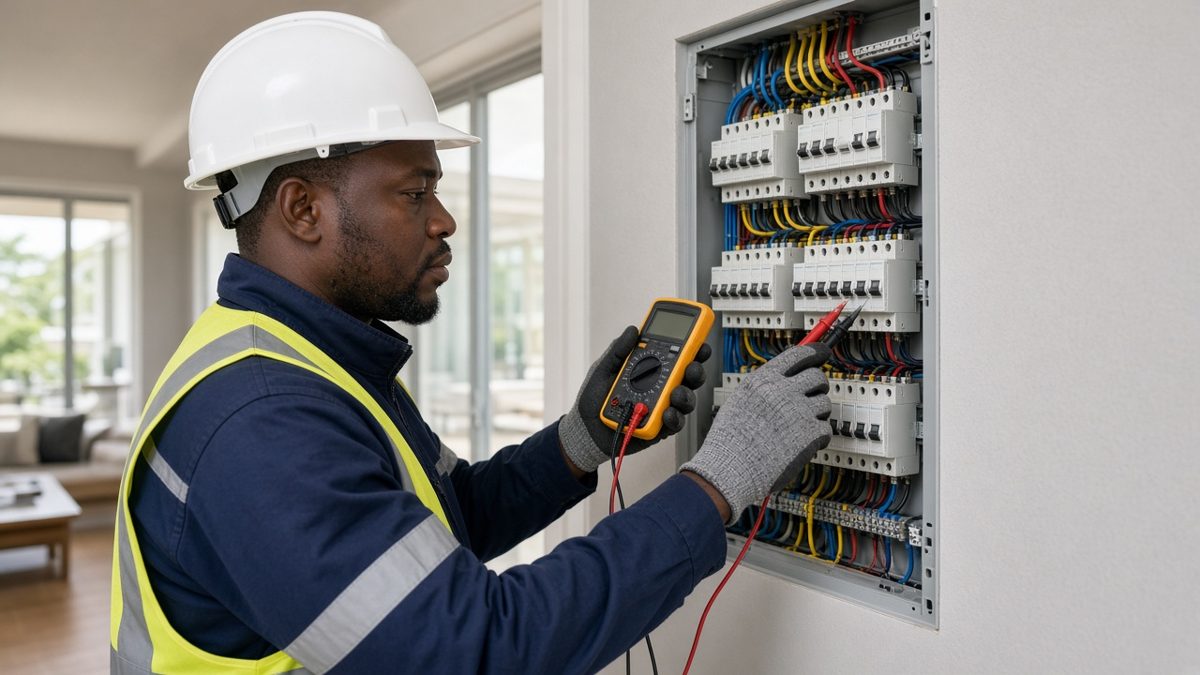
Every new estate, every solar installation and every shop that opens in Nigeria needs a competent electrician, and good ones are booked weeks ahead. Electrical work is also one of the trades where shortcuts can kill, which is why the path to becoming a trusted, certified electrician matters as much as the skill itself. If you want to know how to become an electrician in Nigeria, this guide sets out the routes, the certificates that count, how long it takes and how to find paying work.
Quick answer: train through an apprenticeship, a technical college or a polytechnic, earn your Federal Ministry of Labour Trade Test grades, build documented experience, then apply for NEMSA competency certification in the category that matches your qualifications. Basic skills take months; formal certification usually takes several years of supervised work.
The three main routes
| Route | How it works | Typical length | Best for |
|---|---|---|---|
| Apprenticeship | Work under a master electrician on real jobs | About 2 to 4 years, depending on the arrangement | Learning fast on site and building contacts |
| Technical college or vocational centre | Structured Electrical Installation and Maintenance programmes | Usually 2 to 3 years | A recognised certificate and solid theory |
| Polytechnic (ND/HND) | Electrical/electronic engineering technology | ND 2 years, HND a further 2 | Higher-level roles and contractor work |
Many of the best electricians combine routes: a technical certificate for theory and an apprenticeship for real-world speed and judgement. The National Board for Technical Education (NBTE) keeps a register of approved Electrical Installation programmes, so check that any school you choose appears on it.
Certificates that matter
Trade Test (Grades III, II and I)
The Federal Ministry of Labour’s Trade Test is the traditional proof of competence for artisans in Nigeria. You progress from Grade III to Grade II and then Grade I as your experience grows. Many employers and contractors still ask for it, and it supports later certification.
NEMSA competency certification
The Nigerian Electricity Management Services Agency (NEMSA) certifies electrical installation personnel. According to NEMSA’s published certification scheme, applicants apply online, pay a ₦2,000 application fee, upload qualifications, a passport photograph and evidence of completed electrical work, and then sit a written and oral competency assessment.
NEMSA groups personnel into categories by qualification and experience. Its scheme describes, for example:
- Category D: First School Leaving Certificate, Trade Test certificates and at least five years’ experience.
- Category C: an ND or City and Guilds intermediate qualification and at least three years’ experience.
Higher categories require higher qualifications. Always confirm current requirements and fees directly with NEMSA before applying, as schemes are revised from time to time.
What you will learn
- House wiring: conduit and surface wiring, socket and lighting circuits.
- Distribution boards, breakers, RCDs and earthing.
- Reading drawings and estimating materials.
- Testing and fault-finding with a multimeter and insulation tester.
- Generator changeover switches and inverter connections.
- Safety: isolation, lock-off procedures and personal protective equipment.
Solar is now a natural extension of electrical work. Electricians who understand panels, charge controllers, batteries and inverters are in especially strong demand. Our data study on Nigeria’s solar and inverter search boom shows how quickly that interest has grown.
Tools for your first kit
| Tool | Why you need it |
|---|---|
| Insulated screwdrivers and pliers | Everyday work, safely |
| Digital multimeter | Testing voltage, continuity and faults |
| Wire strippers and cutters | Clean terminations |
| Voltage tester pen | Quick checks before you touch anything |
| Drill and bits, chisels, hammer | Chasing walls and fixing boxes |
| Measuring tape, spirit level, fish tape | Neat, straight installations |
| Gloves, safety boots, goggles | Non-negotiable personal protection |
For a fuller checklist, see our guide to essential tools used by electricians.
How long does it take?
You can be useful on site within months, but becoming an electrician that clients trust with a whole building usually takes several years of supervised work. NEMSA’s experience requirements, five years for Category D in its published scheme, give a realistic sense of the timescale for formal certification.
What electricians earn
Earnings depend on your city, specialism and reputation. Electricians who handle full building wiring, solar installations or commercial maintenance typically earn far more than those who only fix sockets. Our guide on how much an electrician costs in Nigeria in 2026 shows the ranges customers are quoted, and the top 10 high paying handwork jobs explains why electrical work ranks so highly.
Getting your first clients
- Keep a photo record of every neat board and finished installation. Clients judge electricians by tidiness.
- Explain before you quote. Customers trust electricians who tell them what is wrong in plain language. Our article on questions customers ask before hiring an electrician shows what they are worried about.
- Partner with builders, tilers, POP installers and solar vendors, who constantly need a reliable electrician.
- Make yourself findable. Create a free Worker.ng profile as an electrician so customers in your area can contact you directly. There is no commission. See how others present their work on electricians in Lagos and electricians in Abuja.
Our guide on how to get clients as an electrician in Nigeria goes deeper on marketing.
Mistakes that hold young electricians back
- Working live to save time. Isolate, test and lock off every time. Clients forgive a slower job; nobody recovers from a shock.
- Messy boards. A neat, labelled distribution board is your best advertisement when the homeowner opens it.
- Quoting before inspecting. Old wiring hides surprises. Inspect first, then quote clearly.
- Skipping paperwork. Keep copies of certificates and photos of completed jobs; NEMSA asks for evidence of work.
My honest opinion: the electricians customers recommend are rarely the cheapest. They explain the fault simply, turn up when they say, and leave the house cleaner than they found it.
Frequently asked questions
How do I become a licensed electrician in Nigeria?
Train through an apprenticeship, technical college or polytechnic, earn your Trade Test grades, build documented experience, and apply for NEMSA competency certification in the category that matches your qualifications and years of work.
How long does it take to become an electrician in Nigeria?
Basic skills take months, but full competence and formal certification usually take several years of supervised experience.
Is electrical work a good career in Nigeria?
Yes. Construction, solar and maintenance keep demand high, and a reliable electrician with a strong reputation rarely lacks work.
Enjoying our content? Add Worker.NG as a preferred source on Google.
Add us as a Preferred SourceHave a skill people need?
Create your Worker.NG profile and get discovered by people looking for your skill.
Be the first to comment