Real sites to make money online in Nigeria pay you for work or sales: a client hires you, a customer buys your product, a company pays a commission. Fake ones pay you with other members’ money, and they almost always ask you to pay first.
If a site sells you a package, promises a fixed return, or rewards you for recruiting friends, it’s not a job site. It’s a scheme, and Nigeria has watched dozens of them collapse.
Below is a short history of the big ones, the red flags they all shared, and a five-minute check you can run on any money-making site before you give it your time, your BVN or your money.
Last checked: November 2026. Sources are linked for each case.
Ten years of collapses Nigerians should remember
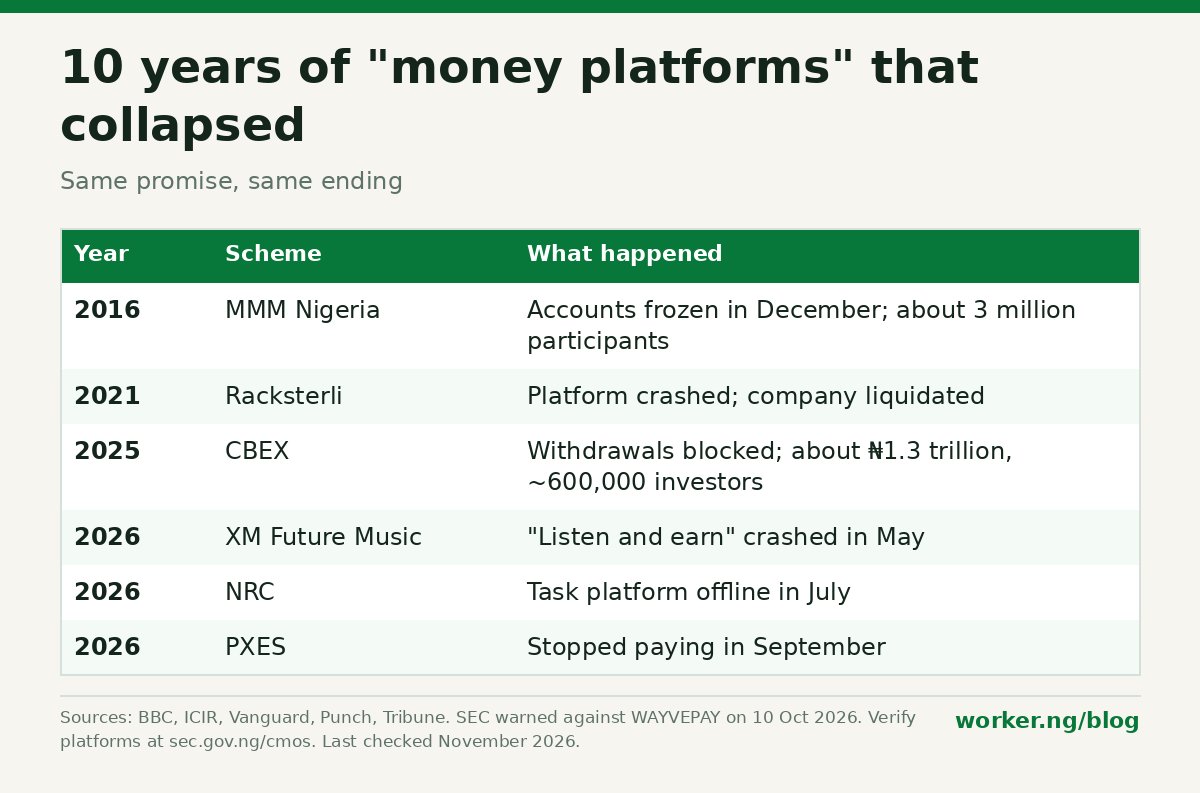
| Year | Scheme | What it promised | What happened |
|---|---|---|---|
| 2016 | MMM Nigeria | “Mutual aid” with high monthly returns | Froze accounts in December; about three million participants affected (BBC) |
| 2021 | Racksterli | Returns on “investments”, celebrity-endorsed | Stopped registrations, platform crashed, company went into liquidation (ICIR) |
| 2025 | CBEX | 100% return in 30 days from “AI trading” | Blocked withdrawals in April; about ₦1.3 trillion from roughly 600,000 investors (Vanguard) |
| 2026 | XM Future Music | Earn by listening to music, up to 100% in 30 days | Crashed in May; Badagry office looted (Punch) |
| 2026 | NRC | Paid daily tasks after buying a package | Website offline in July (Tribune) |
| 2026 | PXES | 25% to 50% returns, some packages 120% | Stopped paying in September; offices in Yola and Kabba looted (Punch) |
And it hasn’t stopped. On 10 October 2026, the SEC warned the public that an online investment platform called WAYVEPAY is not registered to solicit investments (SEC Nigeria). In May, it put out a general notice about unregistered schemes spreading on WhatsApp, TikTok, Instagram, Telegram and Facebook (SEC Nigeria).
What every one of them had in common
Different names, same machinery. Look at the table again and you’ll see:
- You paid to join. A package, a “plan”, a minimum deposit.
- Returns were fixed and high. 100% in 30 days is not a business. It’s a countdown.
- The “work” was pointless. Listening to songs, liking posts, clicking a button. Nobody needs that done, so nobody is paying for it.
- Recruitment was rewarded. Bonuses for bringing in friends and family.
- Early payments were real. That’s what convinced people, and it was paid with newer members’ money.
- Withdrawals slowed before the end. PXES moved members from daily to weekly withdrawals as it grew. CBEX asked users for an extra $100 to $200 “verification” before it shut down (The Guardian Nigeria).
Red flags checklist (screenshot and share)
- You must pay before you can earn.
- The return is guaranteed, or fixed per day or month.
- You earn more by recruiting than by working.
- Nobody can explain who the customer is.
- Withdrawals need a fee, “tax” or “verification”.
- Withdrawal days keep changing or getting longer.
- It lives mostly on WhatsApp or Telegram groups.
- Promoters show CAC certificates as proof it’s safe.
- There’s pressure to join “before the next level closes”.
Number 8 deserves a word. CBEX was registered with the Corporate Affairs Commission as ST Technologies, listed as a consultancy, and promoters used that certificate to look legitimate (Punch). A CAC registration only means a company exists. It says nothing about whether it’s allowed to take your money as an investment.
The five-minute check before you sign up
- Ask “who pays?” On Fiverr, a buyer pays for your design. On Upwork, a client pays for your hours. If the answer is “the platform pays from its trading profits”, stop.
- Check the SEC. Anything offering returns on money must be registered. Search the SEC capital market operators portal.
- Search the name plus “scam” and “withdrawal”. Look at recent X posts and news, not the site’s own testimonials.
- Read the site’s own payout page. Real platforms say how they pay Nigerians: naira bank transfer, Payoneer, monthly dates.
- Never share your BVN or bank login with an “agent” or recruiter. A legitimate platform verifies you through its own app or site.
If you’ve already lost money
Stop sending money, even if they ask for one last fee to “release” your balance. Save screenshots of your dashboard, chats, transfer receipts and the account numbers you paid into. Then report to the EFCC and to your bank. Recovery is hard; after CBEX, the SEC’s director general said publicly that the commission couldn’t recover victims’ funds. Reporting still helps investigators trace the people behind it.
Legit sites to make money online in Nigeria
Freelance marketplaces, remote job boards, creator platforms and affiliate programmes that have a real customer behind every payment. We’ve listed ten of them with fees and payout methods in websites Nigerians use for freelance and online work, and covered apps separately in real money apps that actually pay Nigerians.
The safest money of all is paid for a skill. A tailor, electrician or graphic designer has customers who can see what they paid for. If you have a skill like that, you can list your service on Worker.NG free. If you’re still choosing one, start with our list of tech skills clients pay for.
FAQ
How do I know if a money-making site is legit in Nigeria?
Check who pays you and for what, whether it asks you to pay first, and whether it promises fixed returns. For anything investment-related, confirm registration on the SEC portal.
Is a CAC-registered platform safe?
Not necessarily. CAC registration shows a company exists. Investment platforms also need SEC registration. CBEX had a CAC certificate and still collapsed.
What happened to CBEX investors?
CBEX blocked withdrawals in April 2025. The EFCC later said it had recovered part of the funds and arrested suspects, but most investors have not been repaid.
Where can I report an online scam in Nigeria?
Report to the EFCC, your bank, and the Nigeria Police Force cybercrime unit. Keep every receipt and chat as evidence.
Enjoying our content? Add Worker.NG as a preferred source on Google.
Add us as a Preferred SourceHave a skill people need?
Create your Worker.NG profile and get discovered by people looking for your skill.
Be the first to comment