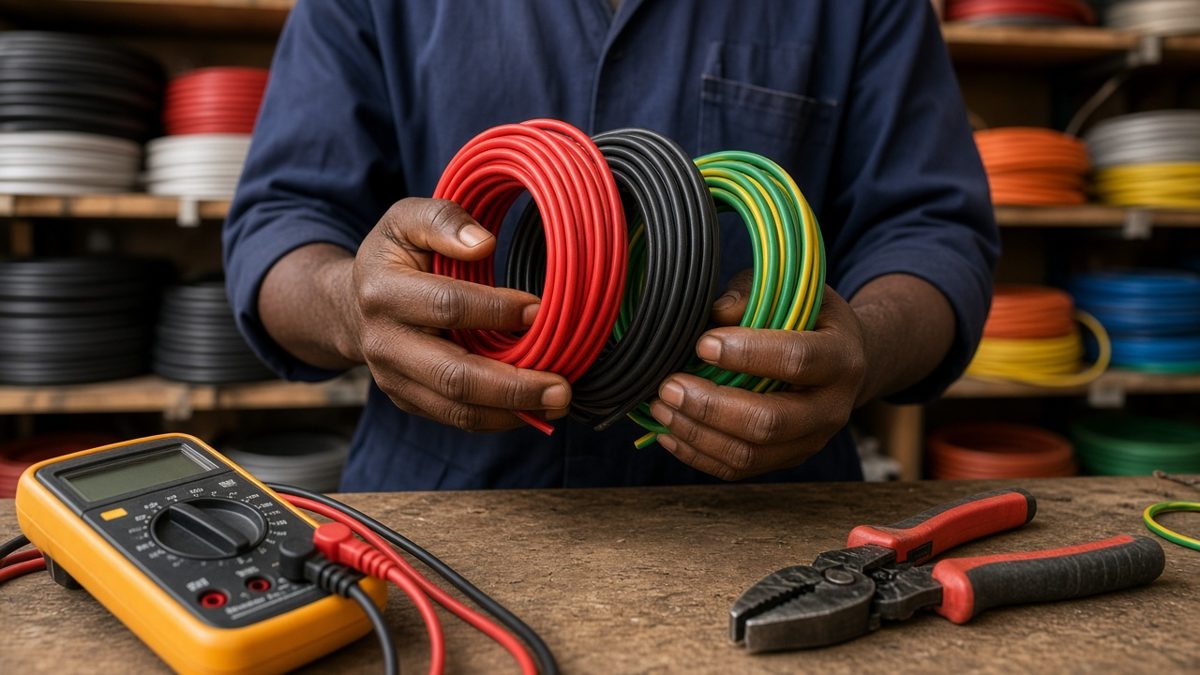
Nigerian electricians most often name Nigerchin, Coleman, Cutix, Kabelmetal and Nocaco as the cable brands they trust for house wiring. In 2026 a 100-metre coil of 2.5mm² single-core costs roughly ₦45,000–₦60,000 for Coleman and Cutix and ₦52,000–₦72,000 for Nigerchin, depending on the seller. The bigger risk isn’t choosing the wrong brand; it’s buying a fake carrying a good brand’s name.
Cables are the one material you can’t easily replace once the walls are plastered, so electricians argue about them more than almost anything. Here’s what practitioners have said publicly, what each brand costs now, and how to tell a real coil from a dangerous copy.
Cable prices in Nigeria (2026)
| Brand | 2.5mm² single core, 100m coil | Made in | Electricians’ shorthand |
|---|---|---|---|
| Coleman | about ₦45,000–₦55,000 | Arepo and Sagamu, Ogun State | Good quality, usually the best price of the big names |
| Cutix | about ₦53,000–₦60,000 | Nnewi, Anambra | Reliable, widely stocked in the East |
| Nigerchin | about ₦52,000–₦72,000 | Lagos | Trusted, and therefore the most faked |
| Kabelmetal | Premium; ask the distributor | Ikeja, Lagos (Nexans affiliate) | Top quality, top price |
| Nocaco | Premium; ask the distributor | Kaduna | Some electricians rate it best of all |
Prices are 2026 retail listings and homeowner budgets published online; cable prices move with copper and the naira, often without notice. A Lagos cable supplier on Nairaland made exactly that point years ago when he stopped posting price lists publicly because prices changed so often that buyers accused him of posting wrong figures.
What electricians have said, brand by brand
Kabelmetal
In a long-running Nairaland thread asking electricians to compare Cutix, Nigerchin, Scan and Kabelmetal, an experienced supplier ranked Kabelmetal, Nigerchin, Miccom and Coleman as “the best cables”, all of similar quality, with Kabelmetal the most expensive. Another contributor rated Nigerchin and Kabelmetal equal at “five stars”.
- Pros: pioneer manufacturer, ISO-certified since 2000, strong on industrial and armoured cables.
- Cons: price. The same supplier warned that its flexible range “is not for kobo-kobo projects”.
Nigerchin
Electricians respect it, which is exactly why fakes exist. A practitioner on the Nigerchin–Kabelmetal–Coleman Nairaland thread described being called to a newly finished house where breakers kept tripping. The cables were labelled Nigerchin, but they were fakes made from an alloy rather than pure copper, and the insulation had peeled so that live and neutral were touching. Original breakers in the distribution board were the only reason the building didn’t burn.
- Pros: long track record, wide availability.
- Cons: the most counterfeited name in the market. Buy from the factory outlet or authorised distributors. One Lagos contributor advised getting it directly from the company’s Ikeja office.
Coleman
Coleman describes itself as the largest cable maker in sub-Saharan Africa. In older Nairaland price lists, Coleman was consistently a few hundred naira cheaper per coil than Nigerchin and Kabelmetal for the same size.
- Pros: value, availability, big local factories.
- Cons: fakes exist here too, so the same checks apply.
Cutix
Cutix holds SON quality marks going back to the 1990s and is common in the South-east. One Nairaland supplier called it “a very good cable” in the same thread.
- Pros: consistent quality, good East distribution.
- Cons: fewer outlets in some northern cities.
Nocaco
Nocaco, made in Kaduna, has loyal fans. In December 2024 a contributor on the Cutix vs Nigerchin thread said that while the others are good, none matches Nocaco, which he considers the best cable in Nigeria.
- Pros: strong reputation in the North.
- Cons: also counterfeited. A Daily Trust investigation that sent market samples labelled Nocaco and Cutix to NEMSA’s Abuja laboratory found serious quality differences between market copies and genuine samples.
How to spot fake cables (from NEMSA testers and electricians)
- Weight and feel. A genuine coil is heavy. Light coils at “too good” prices are a warning sign.
- Insulation strength. NEMSA testers told Daily Trust that substandard wires could be bent and cut with fingers because the insulation was too thin.
- Scratch test. Peel a little insulation and scratch the conductor. Copper stays copper-coloured; copper-coated steel shows silver underneath.
- Magnet test. NEMSA’s advice: if a magnet attracts the wire, there’s steel in it.
- Printing. Genuine cables carry clear, regular printing of the brand, size and standard along the sheath. Fakes often have faint or no inscriptions.
- Where you buy. Factory outlets and authorised distributors. Ask for a receipt with the brand and size written on it.
Which size for what?
| Circuit | Usual cable size |
|---|---|
| Lighting points | 1.5mm² |
| Socket outlets | 2.5mm² |
| Cooker, water heater, AC circuits | 4mm²–6mm² |
| Meter to distribution board | 10mm²–16mm², depending on load |
Your electrician should confirm sizes based on load and run length. A cheaper brand in the right size is safer than a premium brand in the wrong size.
Lola’s note: I’d rather a client pay for a mid-priced genuine coil than a “Nigerchin” that costs ₦15,000 less. If you can’t be on site, ask your electrician to send a short video of the coils with their labels before they’re cut, and keep one offcut from each coil. It costs nothing and settles arguments later.
Electricians: what are you using in your area?
Which brand are you buying this month, what did you pay for a 2.5mm coil, and where have you seen fakes? Share in the comments with your city. We’ll add verified reports to this guide.
More for homeowners and electricians
- How much an electrician costs in Nigeria in 2026 and questions to ask before hiring one.
- Training to become one? Read how to become an electrician in Nigeria and the tools electricians use.
- Going solar? See the battery and inverter brands installers recommend.
- Find electricians in Lagos or Abuja, or list your electrical services free.
Frequently asked questions
Which cable is best for house wiring in Nigeria?
Electricians commonly trust Nigerchin, Coleman, Cutix, Kabelmetal and Nocaco. All are good when genuine; Kabelmetal and Nocaco sit at the premium end, Coleman usually offers the best value.
How much is 2.5mm cable in Nigeria?
About ₦45,000–₦72,000 for a 100-metre coil in 2026, depending on brand and seller.
How can I know original Nigerchin cable?
Buy from Nigerchin outlets or authorised distributors, check for clear printing along the sheath, feel the weight, and scratch the conductor to confirm it’s solid copper.
Is Coleman cable good?
Yes. It’s made in Ogun State, widely used and often cheaper than Nigerchin for the same size.
Enjoying our content? Add Worker.NG as a preferred source on Google.
Add us as a Preferred SourceHave a skill people need?
Create your Worker.NG profile and get discovered by people looking for your skill.
Be the first to comment