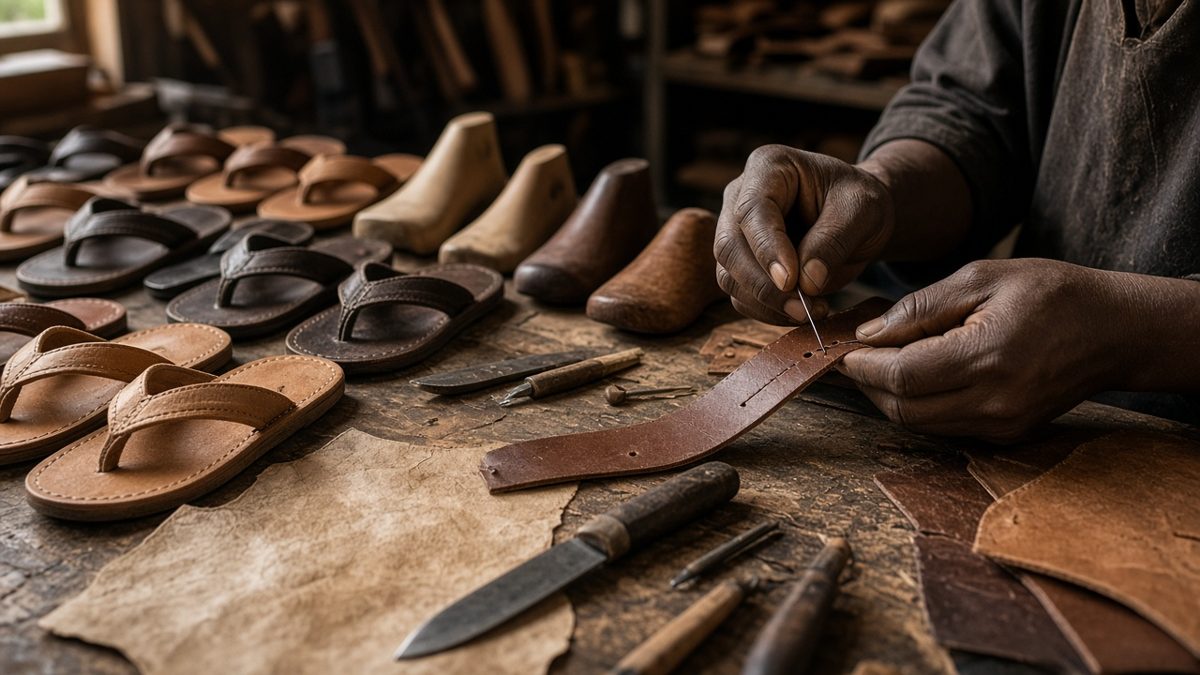
Walk through any Nigerian market on a Saturday and count the feet. Palm slippers, leather sandals, school shoes, the loafers a groom wears once and keeps for years. Somebody made most of those pairs, and a growing share of them were made right here, in workshops of three or four people. If you have been wondering how to start a shoe making business in Nigeria, the good news is that the trade rewards patience and neat hands far more than big capital.
Quick answer: start with one simple product such as men’s leather slippers or palm sandals, learn the full process (pattern, cutting, skiving, stitching, lasting, sole pressing) through an apprenticeship or a season in Aba, set up with hand tools and one industrial sewing machine, and cost every pair before you quote. The money is in batches for boutiques, schools and event groups, not single pairs.
This guide walks you through it in the order that actually works: learning, choosing a product, setting up a small workshop, costing a pair properly and finding buyers who come back.
Start with one product, not a catalogue
The most common mistake new shoemakers make is trying to offer everything. Closed shoes, boots and lace-ups need precise lasting and fitting, and a bad fit means a returned pair and a lost customer. Slippers, palm sandals and simple loafers need fewer operations, so they are the sensible place to learn cutting, stitching and sole attachment.
Pick one line and get very good at it. A maker known for comfortable men’s leather slippers in sizes 40 to 46 will sell more than one who offers twenty designs that each look a little unfinished.
Learn the craft properly first
You can watch videos for inspiration, but shoemaking is learned with your hands on leather. There are three practical routes:
- Apprenticeship with a working shoemaker. This is still the most common path. You learn on real orders, see how materials are bought and pick up the speed that only comes from repetition.
- A short training programme. Some state skills centres and private academies run footwear courses. They are useful for structure, especially pattern cutting.
- A season in Aba. Aba in Abia State, around the Ariaria market in particular, is widely regarded as the centre of Nigerian shoemaking. Even a few weeks there teaches you how batch production and material sourcing really work.
Whichever route you take, ask to be taught the whole process, not just stitching. You want to leave able to design a pattern, cut with little waste, skive edges, stitch, last, press a sole and finish a pair a buyer will pay for.
How the work is organised in Aba
It helps to understand what people mean by “Aba-made”. It is less about one place and more about a way of working. Small workshops each do one stage well: one cuts uppers, another stitches, another lasts and fixes soles, and finishers clean, polish and pack. The Made in Aba cluster mapping study found that 95% of producers across the clusters it studied had fewer than ten employees, and only about 6% were registered with the Corporate Affairs Commission.
That tells you two things. First, you do not need a factory to compete. Second, a small maker who is registered, keeps records and delivers on time already stands out from most of the market.
Tools and equipment for a small workshop
You can start with hand tools and one machine, then add equipment as orders grow. Here is what each stage needs:
| Stage | What you need | Why it matters |
|---|---|---|
| Pattern and cutting | Pattern card, cutting board, sharp knives, scissors, ruler, silver pen | Cutting waste is the biggest hidden cost in shoemaking |
| Skiving | Skiving knife or skiving machine, edge beveller | Thinner edges give neater stitching and cleaner folds |
| Stitching | Industrial flat-bed or post-bed sewing machine, needles, nylon thread | A post-bed machine handles curved uppers better |
| Lasting | Lasts in your best-selling sizes, lasting pincers, tacks, hammer | Buy lasts for the sizes you sell most first |
| Sole attachment | Contact adhesive, brush, sole press, heat source | Poor pressing is the usual reason soles peel |
| Finishing | Sanding wheel, edge ink, polish, brushes, boxes or bags | Packaging affects what boutiques will pay |
Machine prices move with the exchange rate, brand and condition, so get two or three quotes before you pay and test any used machine in person. Many makers pay a nearby workshop to press soles until their volume justifies buying a press of their own.
Buying leather and soles
Good materials are what separate a pair that lasts two years from one that peels in two months. When you buy leather, check that it bends without cracking, that the colour does not rub off on a damp white cloth, and that the parts you will cut are free of holes and brand marks. Once your designs are settled, buy full or half hides rather than offcuts, because offcuts make it hard to match colour across a batch.
Ready-moulded rubber, PU and TPR soles are sold by size. Order a full size run at once so colours match. Buy adhesive from a dealer who stores it properly; old or thinned glue is behind a large share of returns.
How to cost a pair (with a worked example)
Pricing by guesswork is how talented shoemakers stay broke. Cost every pair line by line. Here is an illustrative example for a men’s leather slipper, adapted from a published costing by Pryme. Treat these as example figures and replace each line with quotes from your own suppliers.
| Item | Example cost per pair |
|---|---|
| Leather upper and lining | ₦4,000 |
| Sole | ₦1,500 |
| Insole, adhesive, thread | ₦800 |
| Packaging | ₦300 |
| Share of power, transport and tools | ₦900 |
| Total cost | about ₦7,500 |
In that example the pair sells to a boutique for about ₦11,000, leaving roughly ₦3,500 a pair. At 20 pairs a week, that is about ₦70,000 a week before paying yourself. The lesson is not the exact numbers. It is that the money in this trade comes from batches and repeat bulk buyers, not one-off pairs.
Keep a simple record of how many pairs you cut from each hide. That single number lets you price the next batch accurately.
Who buys handmade shoes in Nigeria
- Boutiques and fashion stores. They want consistent quality, a size run and reliable delivery dates.
- Institutions. Schools, hotels, security companies and churches buy uniform footwear in bulk.
- Events. Grooms’ trains, aso-ebi groups and wedding planners order matching slippers.
- Direct customers online. Instagram, WhatsApp status and TikTok work well for shoes because buyers want to see the finish up close.
Always take a deposit for custom and bulk orders before you buy materials, and put the agreed size list, colour and delivery date in writing, even if it is just a WhatsApp message.
Register, then make yourself easy to find
Register a business name with the CAC once you begin selling to boutiques or institutions; corporate buyers often ask for it before they pay. After that, the next job is visibility. Customers increasingly search for a shoemaker near them before they ever walk into a market.
If you make or repair shoes, create your free profile on Worker.ng so people looking for a shoemaker in your city can find you. Listing is free, there is no commission, and customers reach you directly. If you are in Lagos, see how other makers present their work on the shoemakers in Lagos page.
A simple 90-day plan
- Weeks 1 to 4: settle on one product, make ten sample pairs and wear-test them yourself.
- Weeks 5 to 8: photograph your best samples in daylight, cost each design properly and approach three boutiques with samples and a price list.
- Weeks 9 to 12: take your first batch order with a deposit, deliver on time and ask for a review and a repeat order.
Still choosing which trade to learn? Read our guides to the best handwork to learn in Nigeria as a guy and the top 10 high paying handwork jobs in Nigeria, and see how to choose a handwork to learn.
Mistakes I see new shoemakers make
- Cheap glue. I have watched beautiful slippers come back within a month because the maker saved a little on adhesive. Buy from a dealer who stores it properly and press soles firmly.
- Too many designs too soon. Ten designs in one size run means ten sets of patterns, ten sets of soles and confused customers. Two designs done perfectly will sell more.
- No size chart. Nigerian sizing is inconsistent. Publish your own chart in centimetres and ask buyers to measure their feet. It cuts returns sharply.
- Underpricing to boutiques. If the boutique cannot add its margin and still sell at a fair price, your wholesale price is wrong, not your work.
My honest view: shoemaking rewards stubborn people. The first fifty pairs are humbling. By the two-hundredth, you will cut faster, waste less and quote with confidence.
Frequently asked questions
How much do I need to start a shoe making business in Nigeria?
It depends on whether you start with hand tools and one machine or a full workshop. Many makers begin with hand tools, a single industrial sewing machine and materials for a first batch, and pay another workshop to press soles. Get current quotes for machines and materials in your city before you set a budget.
How long does it take to learn shoemaking?
Simple slippers and sandals can be learned in a few months of steady practice. Closed shoes, which need accurate lasting and fitting, take longer. An apprenticeship on real orders is usually the fastest route to selling quality.
Is shoe making profitable in Nigeria?
It can be, when you produce in batches, cost every pair and build repeat buyers such as boutiques and institutions. Single custom pairs rarely pay well on their own.
Enjoying our content? Add Worker.NG as a preferred source on Google.
Add us as a Preferred SourceHave a skill people need?
Create your Worker.NG profile and get discovered by people looking for your skill.
Be the first to comment